Saturday, 5 January 2013

Photography foray

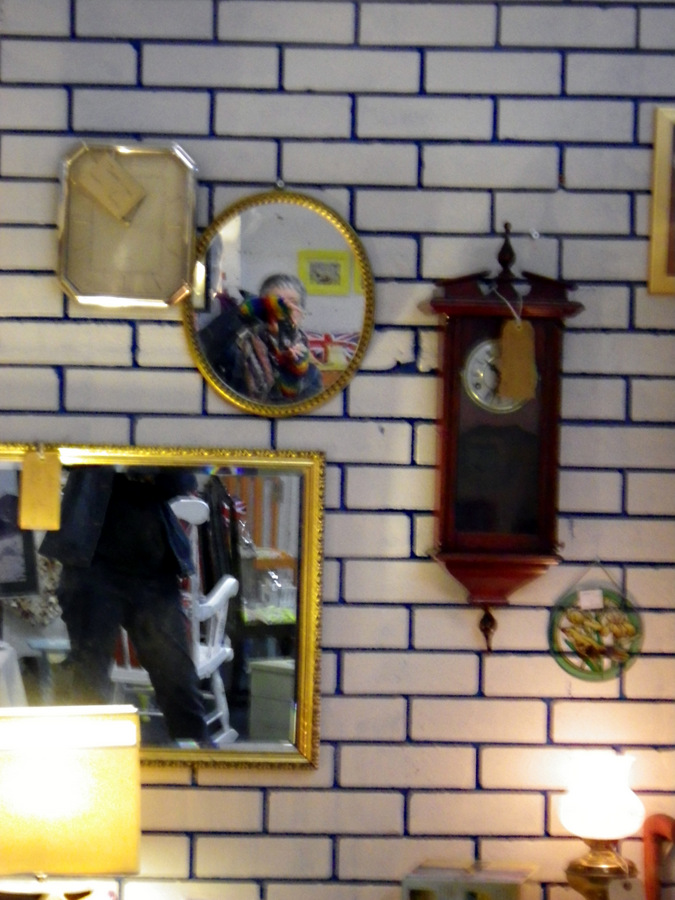
For a mere £1.50 we escaped the dire and dreich weather and visited our  local antiques centre. The huge space is shared between dealers who set out their arrays of multifarious items; a whole confusion of stock, some antique, some purporting to be antique, and then there is the completely baffling.


Monday, 24 December 2012

Spotter or birder?

We went to Leighton Moss yesterday and just as we got into the hide we heard the magic words "bittern to the right, flying over the field". The bittern is one of those birds which is exceedingly elusive, and each time we go to the reserve Q is desperate to find one.  I failed to see any wings of any sort, bitterns or otherwise, Q said she saw a brown blur in the appropriate place, but then rather blew her ornithological knowledge by whispering to me that she didn't realise they could actually fly. Luckily no one else in the hide heard her comment as we were in the company of EXPERTS. The two bittern spotters each had lenses the size of small sheds and as they left to see if they could follow the flight of the bittern a derisory voice was heard saying "Spotters! pah, they're not birders; you need binoculars, not a camera to watch birds properly". We didn't have our binoculars; but even if we had remembered them, they would not  have passed muster  in such erudite company. We did have our cameras, but again our paltry lenses couldn't put us in any spotters' league. Anyway we don't really spot let alone identify  many birds unless they stay still for about 5 minutes.

The robins of Leighton Moss are not at all camera shy and are willing little posers. The top left robin was flitting about near the reed beds and came and ate food out of one of the visitor's hands.


The marsh tit was a first - luckily for us there was an identification board right near the picnic table.


It's a long time since I have seen a greenfinch.


The reasons for the cages around some of the feeders became apparent!


Wednesday, 19 December 2012

Project in progress (part 3)

Lesson learned, don't flap around when fragile butterfly wing bits are on the microscope slide as they have a tendency to catch the breeze and float into oblivion.


This was taken from the upper surface of the butterfly wing, the blue colour isn't obvious as the light is shining through from underneath. What I found interesting were the little scale structures. Are these going to grow into larger scales, or are they subsidiary?  Interspersed among the scales are hair like structures (are they hairs or modified scales?) (Addendum: I've just found out that scales are modified hairs).

I took some pictures at higher magnification, but will need to do some serious Googling to see if I can find anything about the details of types and forms of wing scales. Initial forays into the ether have not been very successful.


Scales were removed using the sellotape method and I then looked at the wing. It would seem that the scales are laid down on a membrane.


The following two images show the same section of wing taken with top lighting (top image) and transmitted light (bottom image).


It is clear  that the scales on the upper surface of the wing are quite different is shape to those on the under surface.


Top lighting (top image) shows the blue colour of the upper wing surface. The transmitted light (lower bottom image) seems to show more detail of the scales.

Wednesday, 12 December 2012

Sparrow and some animation

The sparrows are really making the most of the bird feeders, but one of them doesn't quite seem to have the hang of it - or perhaps it suffers from motion sickness.


There has also been some other displacement activity.


Saturday, 1 December 2012

Project in progress (part 2)


It was possible to look at the butterfly under the stereoscopic microscope without having to take it to pieces. However, in order to get a closer look, I needed to get out the compound microscope which unfortunately meant that this pretty little creature had to be dismantled.

Part of the wing was removed and viewed with top lighting. The scales overlap, like slates on a roof. Long hairs are present in some areas of the wing.


The wings were fringed with longer multi-toothed scales.


I removed some of the scales using sellotape in order that I could view them using the transmitted light shining through from underneath.


The next set of pictures is of strewn scales from the wings.


Part three of the project is to look at scales from the upper and lower surfaces of the wing in more detail.  From initial viewings, it looks as if the lower surface of the wings have longer scales than the upper surfaces. it will be interesting too to see if there is any difference between the pairs of wings.

Monday, 19 November 2012

Project in progress

The wonders of the internet bring you into contact with so many interesting people. Through one such encounter  I became the recipient of  lovely little butterfly, a Common blue (Polyommatus icarus). I have a number of unrealised projects, and one of them is to look the scales on the wings of butterflies and moths. So when the butterfly arrived, I made a start.

 I set up the stereo microscope for those first views, and took pictures with a Dinoscope lens that replaces one of the eyepieces and is directly connected to the computer. Other pictures were taken with the set up as shown below.


The following pictures show the start of the project. Lighting is always a problem, getting sufficient light with no shadows. Then there is the problem of depth of field.


Common blue butterfly (Polyommatus icarus) -eye

Common blue butterfly (Polyommatus icarus) eye


Common blue butterfly (Polyommatus icarus) wing

Common blue butterfly (Polyommatus icarus) wing showing scales


Common blue butterfly (Polyommatus icarus) wing scales


Common blue butterfly (Polyommatus icarus) wing scales

Common blue butterfly (Polyommatus icarus) edge of wing

Common blue butterfly (Polyommatus icarus) edge of wing
 A start has been made, I now want to improve the clarity of the images so will use the compound microscope.

Monday, 12 November 2012

Downs and ups

The down was a sitting down.  I believe that it is impossible to sit on a bookcase full of books without realising (even if said bookcase has somehow been swathed in a jacket carelessly thrown at it). The worst that a book can suffer under said carelessly strewn jacket and then my backside, is a creased page or folded cover. The same cannot be said of a Kindle alas! This I found to my cost the other day. As I recovered the Kindle I saw to my horror that the screen now resembled Etch a Sketch on a high, and accessing any of the scores of books I have stored on it was a total none starter. Yes, I had managed to sit on a virtual bookcase of books.

A lesson learnt the hard way, though at the end of the day, the Kindle is just part of the physical "stuff" that fills our lives, useful and fun but not essential. Luckily for me I was able to go out and get a replacement, and thanks to the wonders of technology all my books were still out there in the ether for me to restock the virtual shelves.


The up is absolutely not "stuff" that can be easily replaced; it was seeing the wonderful spectacle of a starling murmuration. We went out to Leighton Moss one afternoon last week and watched the amazing massed balletics of thousands of starlings as they gathered into a huge crescendo of movement before finally all coming to land in the reed beds.


Attempts at capturing it all on camera merely give a taste of what it was like. Distance and fading light were not conducive to getting good images.


Such was the spectacle that we went again yesterday to see the incredible sight. We put cameras aside and immersed our eyes in the experience. It started with small cohorts of birds which gradually joined forces to form a huge shape shifting pattern, serpent like sliding over the hill top and then morphing into a great fish like  creature ebbing and flowing as more birds joined. As the light caught wings and bodies there was a constant flux of pattern and motion. For their finale, we saw a turn in direction as the shape became a funnel and the birds poured themselves into their night time reed bed roost.