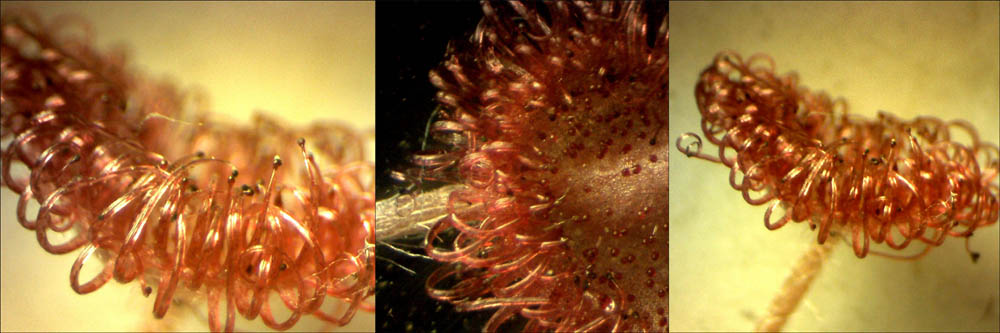
Over the last few days I have uploaded pictures onto my
photoblog of one of the insectivorous plants I have (
Drosera paradoxa). The idea was that as the series progressed I moved closer to the plant. Over the weekend I got out the microscopes and developed the theme a bit further.
Utricularia (Bladderwort) was my starting point. I've never kept this species before, though I have seen it growing in the wild in the waterways in Holland. I bought a plant a couple of weeks ago and its delicate structure belies its sophistication as an animal trapper.
 |
| Utricularia (Bladderwort) |
I put a couple of stems under the microscope and attempted to find some of its subterranean bladder traps, but did not meet with much success, not least because I was not quite sure what I was looking for. A future project methinks.
Pinguilica (Butterwort), a favourite because of its almost all year round flowering. Many insectivorous plants are very canny in that they grow their flowers on long stalks to ensure they get pollinated by those insects that haven't ventured low enough to be trapped and caught.
Butterwort leaves are sticky and glandular and under the microscope the stalked glands can be seen.
 |
Pinguliica (Butterwort) leaf glands
Pinguliica (Butterwort) leaf glands - from a prepared microscope slide
|
Sarracenia (Pitcher plant) was next for examination. The downward pointing hairs and sticky secretions became obvious as the "lid" to the pitcher was put under the microscope.
 |
| Sarracenia (Pitcher plant) |
I looked at the inside of the pitcher too, expecting more downward pointing hairs, but didn't see any. Again, another project for further investigation. Maybe they are smaller ones than those on the lid, perhaps they are not so common in plants in autumn because there are no insects. More investigation and Googling research are required.
Finally I couldn't resist the Drosera (Sundew), always eminently photogenic.
 |
| Drosera (Sundew) |
 |
| Flowering stems coiling and curling high above the leaves |